MONEY & CONTROL · 13 min read
HOW TO STOP AVOIDING YOUR BANK ACCOUNT
A practical way back to your numbers when opening the banking app feels like the hardest part of your day.
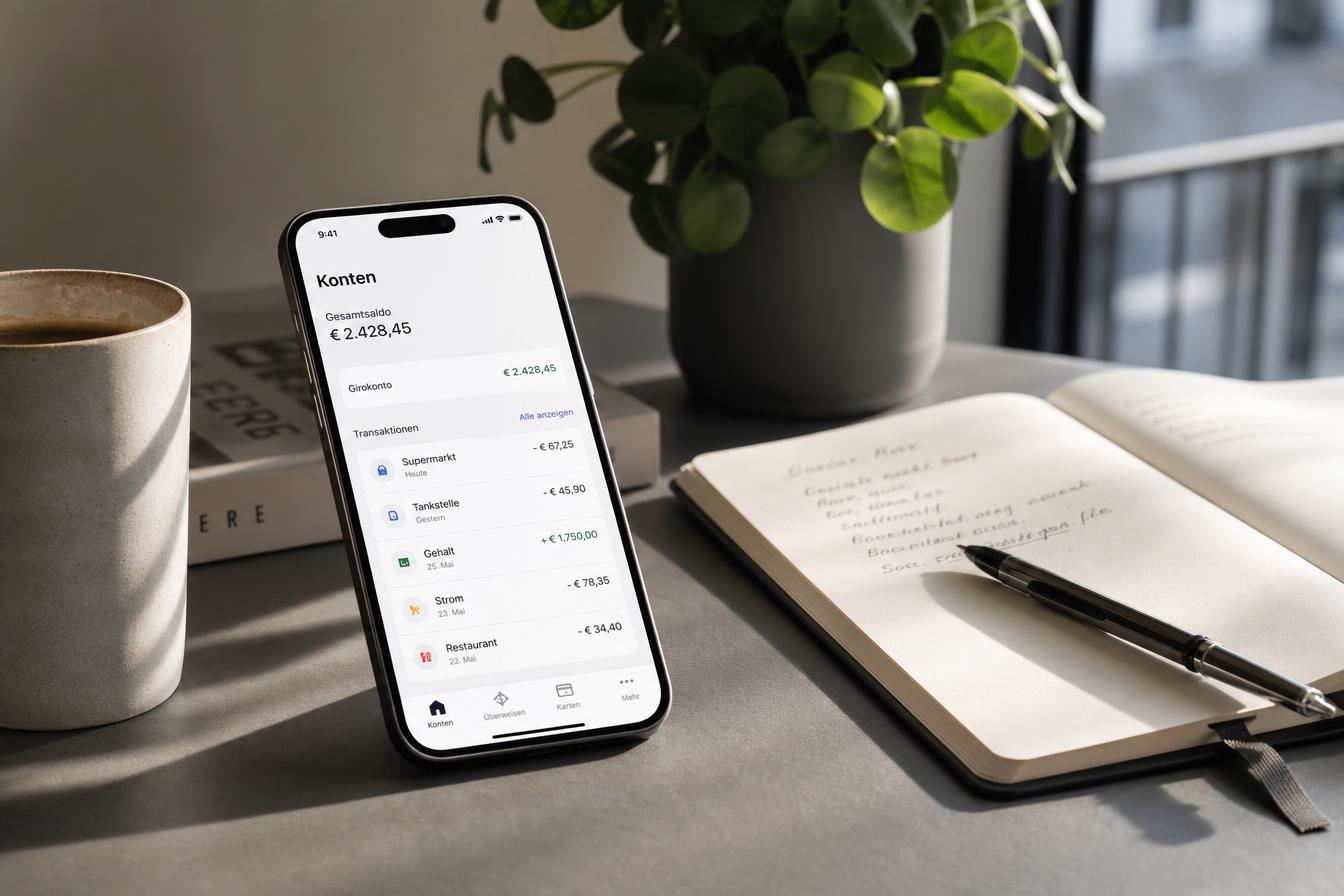
You know the moment. The notification comes in, you see the app icon, and you swipe past it. Maybe you check the balance for half a second with one eye closed. Maybe you have not opened it properly in weeks.
Avoiding your bank account is common and it is not a character flaw. It is what happens when looking at your money has become the thing that ruins your evening. Your brain learns that the app means stress, so it starts steering you away from it.
This article is about getting back in. Not with a strict budget or a new system, but with one honest look, a short routine and a clear idea of what to do with whatever you find.
WHY YOU KEEP AVOIDING YOUR BANK ACCOUNT
Avoidance is rarely about laziness. In most cases the app has become linked to a bad feeling: a balance lower than you hoped, a payment you cannot cover, a purchase you regret, a reminder of a period you would rather not revisit.
Once that link exists, checking your account stops being an admin task and starts being an emotional one. So you postpone it, and the longer you postpone, the more unknowns pile up. Unknowns feel worse than facts, which makes the next look even harder.
- You are afraid the number is worse than you think.
- You do not want to see payments you already feel bad about.
- You have no plan, so looking feels pointless.
- There is too much to sort out, so any single look feels like the start of a long day.
- Money has been stressful for so long that the app itself triggers the stress.
THIS IS NOT ABOUT DISCIPLINE
People who avoid their finances are often the same people who work hard, pay what they can and worry constantly. Avoidance is not the opposite of caring. It is usually the result of caring while feeling powerless.
That matters, because the fix is not to try harder. It is to make looking smaller, shorter and less loaded.
AVOIDING THE NUMBERS DOES NOT MAKE THEM CHANGE
Nothing in your account improves while you are not looking. Direct debits keep going out, subscriptions keep renewing, and a payment that fails quietly today can turn into a fee, a reminder and a collection letter later.
The cost of avoidance is not only financial. It is the background noise: the low level worry that follows you around, the decisions you make on a guess, the small purchases you allow yourself because you have no idea what is left anyway.
Looking does not fix your situation either. But it converts a vague fear into a set of facts, and facts are something you can actually act on. If you want the full picture in a structured way, read our guide on how to get your finances back on track.
START WITH ONE HONEST LOOK
The first look is the hardest, so make it as small as possible. You are not budgeting today. You are not cancelling anything. You are only collecting information.
Pick a moment when you are not already exhausted. Morning tends to work better than late evening. Set a timer for ten minutes so it has a clear end.
- Open every account, including the ones you avoid most.
- Write down each balance on paper or in one note. Seeing it outside the app helps.
- Do not judge anything yet. No comments, no plans, just numbers.
- When the timer goes off, stop. You did the hard part.
IF THE FIRST LOOK FEELS TOO BIG
Open the app, look at the balance for five seconds and close it. That is a complete session. Do it again tomorrow. The goal is to break the link between the app and panic, and short repeated looks do that better than one long painful session.
CHECK WHAT IS COMING IN
Once the balance is on paper, look at what arrives. Salary, benefits, allowances, freelance payments, anything regular. Note the amounts and the dates.
If your income varies, use the lowest of your last three months as your working number. Planning around your best month is one of the quietest causes of money stress.
- Use net amounts, the money that actually lands in your account.
- Write down when each payment arrives, not only how much.
- Keep one time payments separate from regular income.
CHECK WHAT IS GOING OUT
Now scroll through one full month of transactions. Not three months, not a spreadsheet with categories. One month, top to bottom.
Most people find two things: a few fixed costs that are larger than they remembered, and a long tail of small payments that add up quietly. Neither means you did something wrong. It just means the numbers were never visible in one place.
- Mark every payment that repeats every month.
- Mark every payment you did not expect to see.
- Add up the repeating ones. That total is your real fixed cost.
SEE YOUR MONTH ON ONE SCREEN
Want to see where your money actually goes? Try the free Money Reset. You enter your income and your costs and you get your month on one screen, including what is really left over. It runs in your browser and nothing you type is sent to us.
If it is the daily spending that keeps slipping away, the Spending Check does the same for the smaller amounts.
LOOK FOR BILLS AND PAYMENTS YOU FORGOT ABOUT
Avoidance has a side effect: things get lost. A subscription you meant to cancel, a trial that turned into a monthly charge, an insurance policy you no longer need, a service you signed up for during a period you were not tracking anything.
This is often the most rewarding part of the whole exercise, because cancelling a forgotten payment is one of the few money decisions that takes five minutes and works immediately.
- Streaming, apps, cloud storage, gaming and memberships.
- Insurance you doubled up on or no longer need.
- Old phone or internet contracts still running at the old price.
- Anything that renews yearly, which is easy to miss in a monthly review.
THEN LOOK AT THE BIG FIXED COSTS
Once the forgotten payments are gone, the larger bills are where the real room is. Our guides on lowering your monthly expenses and saving on your energy bill walk through those one by one.
WHAT TO DO WHEN YOU SEE A NUMBER YOU DO NOT LIKE
It happens. You look, and the number is worse than the version in your head. That moment passes faster than you expect if you give it something to do.
The useful response is not a plan for the whole year. It is one small action in the next ten minutes, so the look ends with movement instead of dread.
- Cancel one payment you no longer use.
- Write the three payment dates coming up next week.
- Send one message to a company you owe, if you are behind.
- Move whatever is realistic, even a very small amount, into a separate account as a buffer.
- Close the app and do something else. You are allowed to stop there.
SEPARATE THE FEELING FROM THE FACT
A low balance is information, not a verdict on you. It tells you what your month can carry right now. That is exactly the thing you need in order to make better decisions in the weeks ahead.
If the wider situation feels heavier than the numbers alone, our article on starting over when you feel completely lost takes a practical route through that.
CREATE A SIMPLE MONEY CHECK IN ROUTINE
The reason people fall back into avoidance is that they only look when something is wrong. Then checking your account is always bad news. A routine changes that, because most check ins turn out to be uneventful.
Keep it short and fixed. Same day, same moment, same three things. A routine you can keep up beats a detailed one you abandon.
THE DAILY THIRTY SECONDS
Open the app, look at the balance, close the app. That is it. No analysis. This single habit removes most of the fear within a couple of weeks, because you always roughly know where you stand.
THE WEEKLY TEN MINUTES
Once a week, sit down with a coffee and do the same three steps in the same order.
- Check the balance of every account.
- Scroll through the payments of the past seven days and mark anything unexpected.
- Look at what is due before your next check in and decide whether it fits.
THE MONTHLY THIRTY MINUTES
Once a month, look at the bigger picture: what came in, what went out, what changed and whether any fixed cost is worth reviewing. This is also the moment to update your overview in the Money Reset so you are comparing real numbers, not impressions.
WHEN AVOIDING YOUR FINANCES IS CONNECTED TO DEBT
For many people the account is not the real problem. The debt behind it is. Every look at the balance is a reminder of something bigger, so the avoidance is protecting you from a much heavier subject.
Debt tends to feel like one large cloud until it is written down. On paper it becomes a set of names, amounts and dates, and that is far easier to work with, even when the total is high.
- Write down every creditor, the outstanding amount and the minimum payment.
- Add the interest rate where there is one, and the payment date.
- Include the ones people leave off: buy now pay later, an overdraft, an unpaid invoice, money borrowed from family.
- Take care of essential costs and urgent payment problems first. What counts as urgent differs by country, creditor and situation.
PUT YOUR DEBTS IN ONE OVERVIEW
If your debts are scattered across letters, apps and memory, the free Debt Reset puts them in one place and shows your real total and your combined monthly minimum. It can be uncomfortable to see the full number. But once you know where you stand, you can make better decisions and ask better questions.
WHAT TO DO IF YOUR INCOME DOES NOT COVER YOUR EXPENSES
Sometimes you look properly and discover that the gap is real. No routine closes that on its own, and pretending otherwise would be dishonest.
What helps is knowing the size of the gap, because a shortfall of forty a month and a shortfall of four hundred a month lead to completely different decisions.
- Confirm the gap with actual numbers over three months, not one bad month.
- Reduce recurring costs first, since those repeat every single month.
- Check whether you are missing any support, allowance or scheme you are entitled to where you live.
- Look at realistic extra income, but treat it as a supplement rather than a solution.
- If a genuine gap remains, contact official debt support or a financial adviser in your country. That is what those services exist for and using them early usually means more options.
TWO PRACTICAL STARTING POINTS
For lowering what goes out, 30 ways to save money and live better is a broad list you can work through slowly. For bringing something extra in without startup costs, see making extra money with zero budget.
A FIVE MINUTE BANK ACCOUNT RESET
If you read nothing else, do this. It is not designed to solve your situation in five minutes. It is designed to give you your overview back so you can make decisions with your eyes open.
- Minute one: open every account and write down the balances.
- Minute two: note what is coming in before your next payday and on what date.
- Minute three: note the payments that must go out in that same period.
- Minute four: mark one payment you can cancel, pause or question.
- Minute five: write one sentence about what you will do next, and put a weekly check in in your calendar.
WHY THIS WORKS
Five minutes is short enough that you cannot talk yourself out of it, and structured enough that you finish with facts instead of a feeling. Repeat it weekly and the app slowly turns into an ordinary tool again.
WHEN TO GET EXTRA HELP
There is a point where self help is not the right tool. If you are behind on essential payments, receiving collection letters, borrowing to cover basics or unable to face your finances at all, support is the sensible next step rather than a last resort.
In the Netherlands you can start with your municipality or a recognised debt support organisation. In other countries there are usually free, official services for the same purpose. If money stress is affecting your sleep, your health or your relationships, speak to your doctor as well.
Our Get Help page lists where to go. If gambling is part of the picture, Gambling Recovery has the specific steps and support options for that.
A CALM NEXT STEP
Money is rarely only about money. It usually sits on top of habits, choices, stress and the direction things have taken. If you want to look at that wider picture at your own pace, Finding Your Way Back is our practical digital guide for rebuilding step by step.
Some links on this page may be affiliate links. If you use one, we may earn a small commission at no additional cost to you. Not every link is an affiliate link, and we never take gambling or betting partnerships. Read the full disclosure
OUR GUIDE
Finding Your Way Back
A calm, practical digital guide for rebuilding your money, your habits and your direction, one step at a time. Instant download after payment.
€9.99 · instant download
FREQUENTLY ASKED QUESTIONS
Short, practical answers to the questions people ask most about money avoidance. This is general information, not personal financial or legal advice.
WHY DO I AVOID CHECKING MY BANK ACCOUNT?
Usually because looking has become linked to a bad feeling: a low balance, a payment you cannot cover or a period you would rather forget. Your brain avoids what it expects to hurt. Short, frequent looks weaken that link far better than one long session.
HOW OFTEN SHOULD I CHECK MY BANK ACCOUNT?
A quick daily glance at the balance and one slightly longer weekly check in works well for most people. The point is a fixed rhythm, so that checking is normal rather than something you only do when something goes wrong.
WHAT SHOULD I DO IF I AM SCARED TO LOOK AT MY BALANCE?
Make the first look tiny. Open the app, look for five seconds, close it. Do that a few days in a row before you look at any transactions. If it helps, ask someone you trust to sit with you the first time.
WHAT IF I DO NOT HAVE ENOUGH MONEY TO PAY MY BILLS?
Take care of essential costs first, and contact the companies you cannot pay before a payment is missed, since many can offer an arrangement. If the shortfall keeps returning, contact official debt support or a financial adviser where you live. Getting help early usually means more options are still available.
CAN CHECKING MY BANK ACCOUNT ACTUALLY REDUCE FINANCIAL STRESS?
It does not change your balance, but it does replace guessing with facts, and most people find the unknown heavier than the number itself. Knowing what is coming in and going out also makes everyday decisions simpler. If stress remains high, treat that as a reason to seek support rather than a sign you are doing it wrong.
SEE YOUR MONTH ON ONE SCREEN
The free Money Reset turns your income, your fixed costs and your spending into one clear picture. It takes about ten minutes and everything stays on your own device.
Some links on this page may be affiliate links. If you use one, we may earn a small commission at no additional cost to you. Not every link is an affiliate link, and we never take gambling or betting partnerships. Read the full disclosure
This article is general information and education. It is not personal financial, tax or legal advice, and rules differ by country. If you are facing serious payment problems, contact official debt support or a qualified financial adviser where you live.
NEXT STEP
Are debts the reason you avoid the app? Put them into one overview and see the real total.
OPEN THE DEBT RESETCONTINUE FROM HERE
Two natural next steps, whichever chapter you are working on.